Mathematics is a fundamental tool for our cognitive development and our ability to adapt to the world around us. We apply it in many aspects of everyday life, from doing the shopping to telling the time or understanding magnitudes. For this reason, it is important that we become familiar with mathematical reasoning from an early age, paying special attention to the learning of mathematics throughout academic education.
It is true, however, that acquiring mathematical thinking skills can be a challenge for many people, and it is often considered one of the most complex and difficult subjects at school. This challenge can be especially significant for children with mathematical learning difficulties or with dyscalculia. When mathematical difficulties arise, it is crucial to offer additional support to help pupils adapt to the academic pace.
Cognitive development of numerical learning
Numerical learning is an essential life skill, which begins to be worked on from an early age. As children grow, they pass through different stages of cognitive development on their way to understanding numbers and mathematics.
Number sense
Number sense corresponds to the initial phase of numerical learning, in which children begin to understand the difference between magnitudes. In an optimal scenario, the child is able to understand, for example, that a group of five objects is larger than a group of two objects. However, an alteration in the functioning of the intraparietal sulcus can lead to difficulty in developing the principle of “magnitude”.

Mental number system
After achieving the ability to perceive magnitudes, in the mental number system stage children are able to associate quantities with a word. For example, a group of three objects can be associated with the word “three”. Even so, children with specific language impairment (SLI) may find it harder to associate magnitudes with words, owing to their limitations in language acquisition.
Arabic number system
In the previous phase a group was associated with a word, but, with the learning of Arabic numerical representation, during the Arabic number system phase quantities can be associated with a number written in Arabic representation. For example, a group of three objects can be linked to the number “3”. It should be noted, however, that both dyslexia and dyscalculia can limit the reading of the Arabic representation of numbers, preventing this phase from being fully achieved.

Mental number line
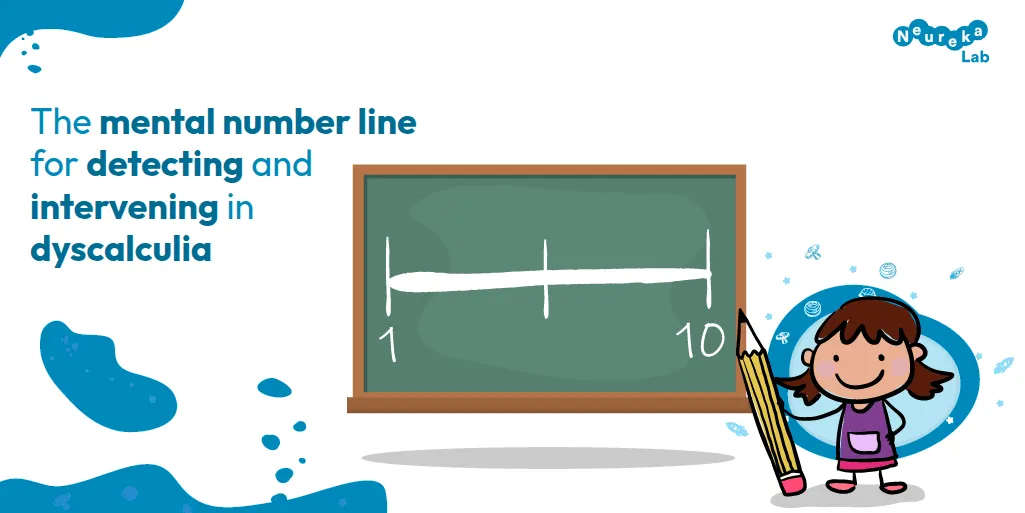
Finally, on the mental number line, and once the different forms of numerical representation are understood, the child is able to order strings of numbers sequentially. In other words, they can mentally organise the numbers that fall, for example, between 1 and 10. Any impediment to completing the earlier phases of the cognitive development of numerical learning can have a negative impact on the acquisition of the mental number line. It is therefore important to detect possible difficulties at the different stages of this development.

Mental number line estimation
The mental number line estimation task is an activity that consists of placing a number on a line without the help of any measuring tool. It is used to represent numbers from smallest to largest, and the first and last numbers of the line are usually given as a reference. It comprises a starting point, which is generally zero, and a final number, which is the largest number in the sequence. Each “point” or space on the number line represents a specific number, and the distance between these points is uniform. The mental number line estimation task is used to assess a person’s ability to understand and use the sequential structure of numbers.

During this task, the child can be presented with a series of numbers and asked to place them on a number line, which involves estimating the relative position of each number in the sequence. For example, the child can be asked where the number 6 lies on a number line from 0 to 10, and they are expected to be able to place it between 5 and 7, using the centre of the line as a reference to locate the number 5 and moving slightly to the right along the number line.
Benefits of the mental number line estimation task
The mental number line estimation task is frequently used in the assessment of mathematical skills in children, and can be a useful indicator of a child’s numerical understanding and mental calculation ability.
This task has attracted particular attention in various scientific studies as a way of assessing, monitoring and predicting the mathematical performance of the children who carry it out, since it brings together the following benefits:
- It is a simple activity to carry out and requires little time to complete.
- Its workings are easy to understand.
- Its level of difficulty can be varied - extending the numbers, adding negatives or decimals, etc.
- It reinforces knowledge of the mental number line.
Detecting and intervening in mathematical difficulties and dyscalculia
The mental number line estimation task is a useful tool for detecting mathematical difficulties and dyscalculia, since it requires a basic understanding of numerical structure and order, belonging to the final phase of the cognitive development of numerical learning. Acquiring the mental number line involves the consolidation of number sense, the mental number system and the Arabic number system.
The ability to estimate the location of numbers on the number line is important for many mathematical skills, such as problem solving and mental calculation. If a child has difficulty estimating the location of numbers on the number line, they may also have difficulty understanding more advanced mathematical concepts.
Timely detection of mathematical learning difficulties or dyscalculia through the mental number line estimation task allows teaching staff and education professionals to design specific interventions to help pupils overcome these difficulties. At the same time, carrying out this task repeatedly helps to strengthen the ability to estimate on the mental number line, accustoming the child to working with sequences and helping them improve their cognitive development of numerical learning.
NeurekaNUM
At NeurekaLab we have developed NeurekaNUM, a scientifically validated gamified method for working on mathematical difficulties and dyscalculia at home with children aged 5 to 8. For a richer experience, we present NLab Family, the mobile and tablet application available for Android and iOS, with which children can play while they learn anywhere and at any time. It offers different activities, including the mental number line estimation task, to work on sequences, visuospatial skills and magnitudes.

Scientific evidence: