The current educational landscape is undergoing significant changes centred on competency-based teaching. This approach prioritises students’ acquisition of essential skills, with the aim of preparing them for the challenges of academic, professional and social life. In this context, the incorporation of digital technology emerges as a key element in improving this process, connecting students with everyday reality and ensuring better preparation for the demands of an increasingly digitalised world.
What is self-directed learning?
In recent years, emphasis has been placed on fostering pupil autonomy within the current educational framework. This new perspective seeks to provide pupils with a wide range of tools that strengthen their capacity to adapt not only in education, but also in the social and professional spheres they will encounter in the future. This approach aims to cultivate students’ ability to take control of their learning, thereby promoting comprehensive development that adapts to the demands of a changing society.
On this basis, self-directed learning, or autonomous learning, is a process of acquiring knowledge in which the student actively assumes responsibility for planning, carrying out and evaluating their own learning process. For this to be possible, teachers play a crucial role as mediators, guiding pupils in developing the skills needed to learn autonomously. The teaching team is therefore responsible for offering support in defining learning goals, providing resources, encouraging reflection and contributing to pupils’ growth so that they learn how to learn.
Benefits of self-directed learning in education
Several studies agree that self-directed learning can be developed from childhood, and its use brings benefits in education, especially during the first years of school:
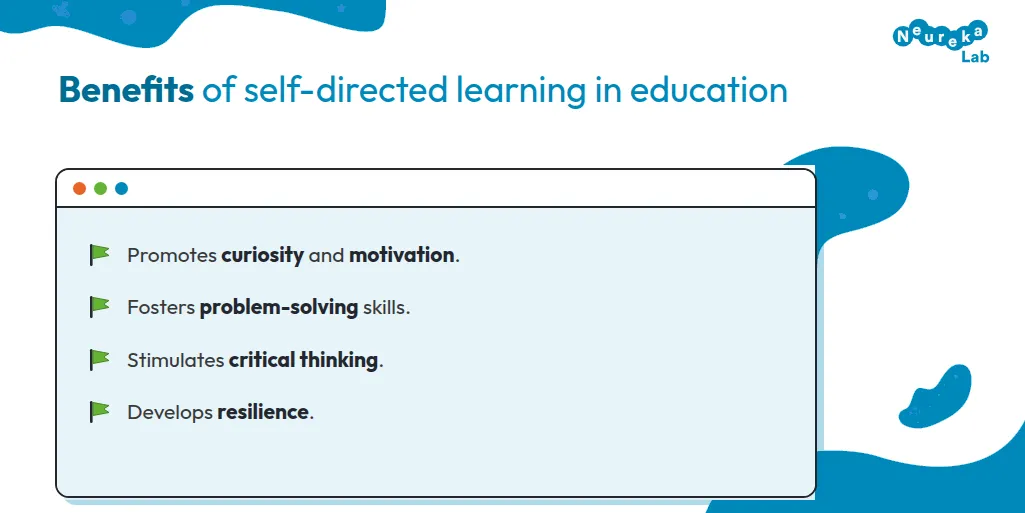
- It promotes curiosity and motivation. Becoming active agents in their learning allows pupils to set their own objectives and focus their education on areas of knowledge that interest them.
- It fosters problem-solving skills. Through self-directed learning, which involves setting goals autonomously, students are able to tackle educational challenges with creativity and initiative.
- It stimulates critical thinking. Self-directed learning creates an environment in which the student takes control of their education, planning, executing and evaluating their educational process.
- It develops resilience. Children who experience autonomous learning learn to overcome obstacles and adapt to educational challenges with confidence and determination.
Self-directed learning provides the tools to explore the world actively and critically. Learning to be autonomous from childhood helps develop a positive attitude during their education and, in the long run, children become active agents in the construction of their own knowledge.
Digital technology and video games as educational tools
New technologies, and especially video games, have evolved beyond simple entertainment to become powerful educational instruments that enhance self-directed learning. Research shows that digital technology, such as interactive environments and internet access, offers pupils a key tool for seeking information and overcoming obstacles during their learning process. Several studies highlight that, at moments of standstill or blockage, children’s ability to use digital technology to search for information online and access various reference sources is essential for progressing in their learning.
Serious video games, applied in education, have emerged as unique learning environments that not only captivate participants but also pursue specific pedagogical objectives. Through interactivity and immersion, video games offer educational experiences that positively influence cognitive change, motivation and sociocultural outcomes, and provide a structured environment in which the material learned can be stored more durably, offering a solid foundation for building further knowledge. However, it should be noted that the effective integration of these tools requires a comprehensive approach and the active support of teachers to guarantee their positive impact on pupils’ learning.
Validated considerations and recommendations for technology in education
Video games and digital technologies play a fundamental role in autonomous learning, since they provide pupils with interactive and immersive tools that promote decision-making, problem-solving and the autonomous management of their learning processes. In particular, serious video games stand out as educational tools that offer virtual environments specifically designed to achieve pedagogical objectives. The interactivity inherent in video games drives the child to be the architect of their own learning, since they must direct their actions to achieve the game’s objectives. This active participation contributes to the development of autonomy, decision-making ability and motivation in the learning process.
Scientifically validated recommendations

The European Commission has highlighted the critical importance of pupils being able to learn autonomously throughout their formal education, with an emphasis on the ability to identify and set goals, motivate themselves and develop resilience in order to succeed in lifelong learning. This autonomy in learning becomes a key skill for facing the social and professional challenges of the future. In this context, technologies, and especially video games and digital tools, emerge as valuable support in the self-directed learning process, providing a source of information, motivation and experience that can contribute significantly to the development of students’ knowledge and skills.
For this reason, research in this field highlights some considerations to bear in mind when integrating digital technology and video games to foster self-directed learning in the classroom:
- Training the teaching team. Teachers must receive specific training to use educational technologies and video games effectively in students’ learning, ensuring that they can act as expert mediators in this context.
- Active supervision by teachers. Teachers must maintain active supervision during sessions involving technology and video games, intervening when necessary to provide guidance and support, and ensuring that learning takes place effectively.
- Careful selection of serious video games and digital content. It is important to know how to identify serious video games that meet pedagogical objectives, taking into account their suitability for the curriculum and their capacity to foster decision-making and problem-solving.
- Establishing rules and regulations. It is advisable for teachers to help establish clear rules and regulations for the use of technology and video games in the classroom, providing guidelines on how to integrate them effectively and avoid unwanted distractions.
- Defining clear goals and objectives. It is essential that teachers help students set clear learning goals and objectives in relation to the use of technology and video games, thereby fostering their autonomy in achieving these objectives.
- Encouraging collaboration between students. Teachers must promote collaboration between students through the use of technology and video games, favouring the joint construction of knowledge and fostering social and collaborative skills.
Scientific evidence:
Karpova, Svetlana Ivanovna; Chirich, Irina Viktorovna; Avtsinova, Galina Ivanovna; Shtukareva, Elena Borisovna; Ukhina, Tatiana Viktorovna; Gordeeva, Tatiana Aleksandrovna (2021). Information and communication technologies in education: video games as an effective environment for the development of self-directed learning of students. Webology, 18. DOI: 10.14704/WEB/V18SI05/WEB18218
Marcos, María; Moreno, Miguel (2020). La influencia de los recursos audiovisuales para el aprendizaje autónomo en el aula. Anuario Electrónico de Estudios en Comunicación Social “Disertaciones”, 13(1), 97-117. DOI: http://dx.doi.org/10.12804/revistas.urosario.edu.co/disertaciones/a.7310
Thomas Howard Morris & Matthias Rohs (2023). The potential for digital technology to support self-directed learning in formal education of children: a scoping review, Interactive Learning Environments, 31:4, 1974-1987, DOI: 10.1080/10494820.2020.1870501