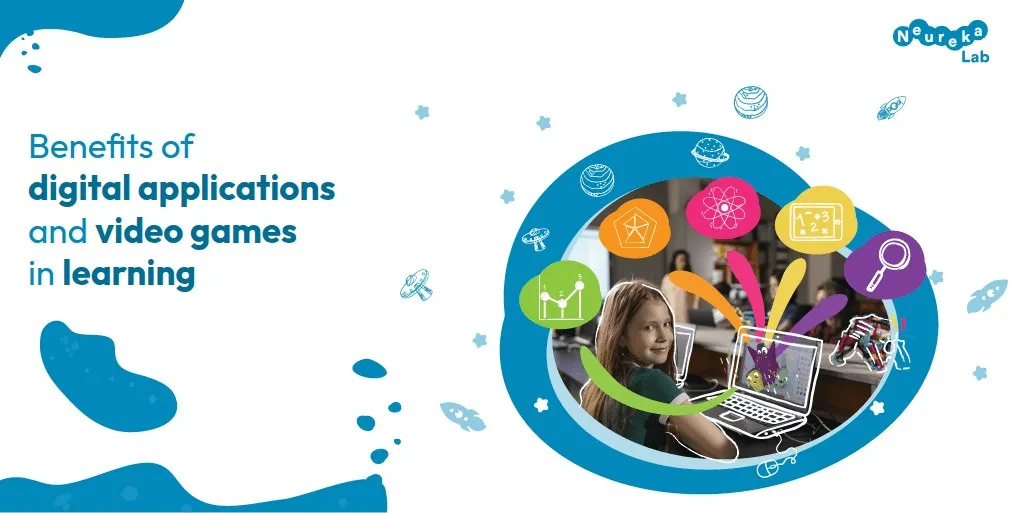
The advance of information and communication technologies (ICT) has reached different areas of life, bringing improvement through digital transformation. In recent years, ICT has evolved and been incorporated into new forms of teaching in order to achieve better academic results and, in general, to foster adaptive learning environments for every student profile.
According to recent research, the capacity to process information is acquired through two main channels during learning: the visual and the auditory. The greater the simultaneous involvement of both channels, the greater the retention of information. In this sense, both digital tools and video games offer a dynamic experience, in which the visual and auditory components play a relevant role in stimulating the learning process.
Digital tools for learning
It is often necessary to break with traditional teaching methodology to promote new stimuli and experiences, especially for profiles that require more attention. In the case of learning difficulties, these can benefit from technologies that have been planned from a scientific perspective with the aim of improving each child’s individual situation in their learning process. Scientific research works to understand the causes and characteristics of the different learning difficulties in order to create resources adapted to each child’s specific needs.
There are different types of digital tools aimed at learning, depending on their specific objective. These tools have been developed over the years to achieve better academic results.
Tutorials
Tutorials are learning tools that deliver new knowledge through different units. Progressively, the student acquires new material in small doses. Tutorials can be presented in different formats, depending on the teaching objectives in each case. Some of the most common formats are:
- Text: The educational content is presented in writing but, unlike a conventional syllabus, a tutorial explains step by step how to achieve a specific academic objective, which can then be reproduced in practice.
- Infographics: As in the previous case, the steps for carrying out a practical activity are explained, but in a schematic way and with graphic representations. Because of their visual component, infographics help retain more information than plain text.
- Video: This is the most common format in recent years, and it allows information to be captured through both retention channels, the visual and the auditory, so that new knowledge is internalised more effectively.
Search platforms
Search platforms are information repositories that provide specific knowledge requested by the student. In other words, the student searches for a specific concept and the platform offers results according to their search. The content is usually textual and links countless related concepts through hypertext.
Drill and practice programmes
Drill and practice programmes are dynamic tools for putting previously acquired knowledge into practice. They consist of various exercises aimed at reviewing and/or assessing the student’s academic progress. These exercises are usually presented in a dynamic and interactive format and often, once the activities are completed, the tool provides immediate feedback to the student on their results.
Simulators
Simulators play with real-world space to provide experience-based forms of learning. Through technologies such as virtual reality (VR) or augmented reality (AR), students are asked to participate actively in practical activities. Incorporating real-world experience adds value when it comes to taking in new information.
Video games and gamification
Research into the development of education has observed that combining the most notable features of digital tools brings better results during children’s learning process. Video games are designed to put different capacities and skills into practice in specific environments, and these resources can be extrapolated to fields such as education.
Gamification is the act of transferring game mechanics for the benefit, in this case, of education. Bringing together the benefits of the digital tools mentioned above, video games have been shown to enhance children’s skills through the experimentation, interaction and cooperation that game mechanics offer.
Technologies for detecting and intervening in learning difficulties
Digital applications and video games foster creativity, motivation, participation, cooperation and memory. They are technologies applied not only to intervention in learning difficulties, but also to their detection, since they feature automated data processes that make it possible to assess the child’s progress.
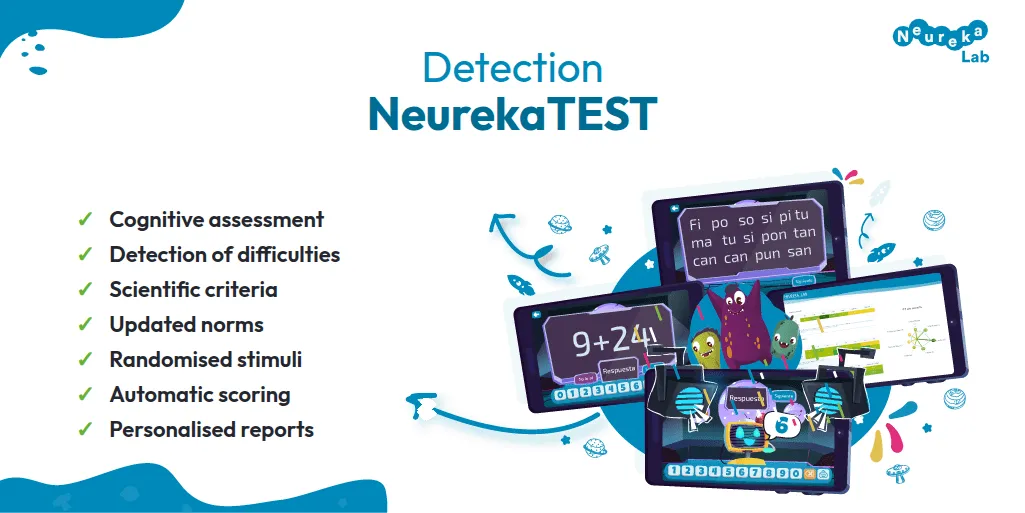
NeurekaTEST
The NeurekaTEST method is designed to assess and detect learning difficulties in different areas of knowledge, through a range of activities aimed at understanding the basic functions in children’s learning:
- NeurekaCALC: numerical processing and calculation.
- NeurekaLEC: reading processes.
- NeurekaMEM: working memory.
- NeurekaATT: sustained attention.
- NeurekaTDAH: presence of signs of ADHD.
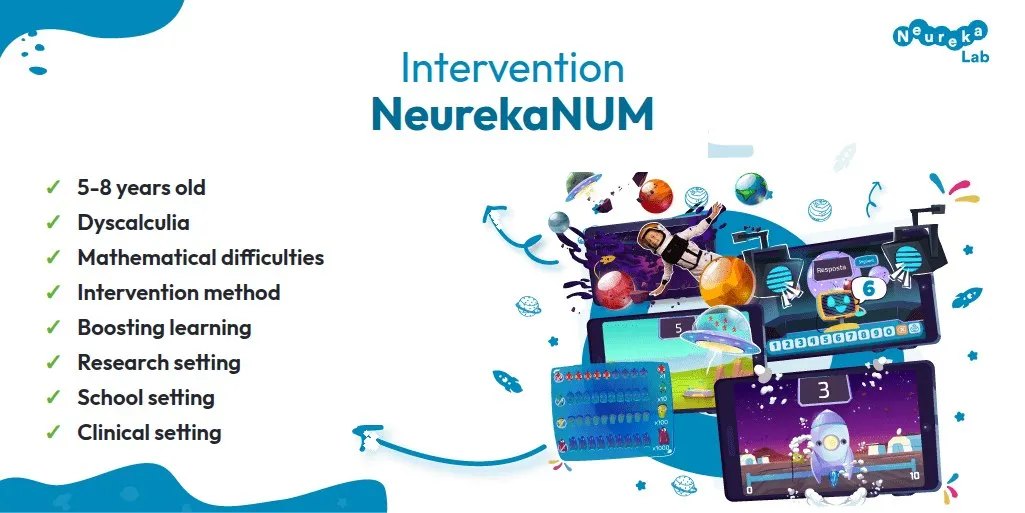
NeurekaNUM
The NeurekaNUM method is an intervention tool for improving the learning of mathematics. It is aimed at children with mathematical difficulties or dyscalculia, with the objective of speeding up numerical processing and calculation skills.