The right to education is a fundamental pillar of individual development. In this context, guaranteeing that all children, regardless of their individual differences, enjoy access to quality education becomes an essential commitment for building a more inclusive and promising future for society as a whole.
Scientific research in the field of education has highlighted the presence of several groups with special educational needs, which open up a pathway towards a more adaptive approach to education. It is therefore essential to recognise and address special educational needs rigorously, since the inclusion of these groups in the education system is not only an ethical matter but also represents a challenge in fostering diversity and promoting equal opportunities.
What is high intellectual ability?
Although educational concerns tend to revolve around learning difficulties, another group with special educational needs is children with high intellectual ability. High ability, like learning difficulties, has a neurobiological basis, so support must be provided to allow these children to develop their full potential. In the academic field, the term high intellectual ability refers to those individuals who show intellectual performance significantly above the average of their peers in terms of cognitive skills. However, defining a homogeneous set of characteristics shared by this group is challenging, owing to the marked diversity of profiles it presents. Some individuals excel in specific areas, such as mathematics or music, while others display high levels of creativity or exceptional social skills.
Despite an apparently promising outlook for these children, they are considered part of the group of children with special educational needs which, if not addressed, can pose a risk of school failure. According to Pardo de Santayana (2004), both children with learning difficulties and children with high abilities represent the largest percentage of the child population at risk of school failure. The main factor that can contribute to this school failure is the lack of identification and appropriate attention to their educational needs in the school environment, leading to disengagement and underachievement.
Detecting high intellectual ability
Early identification is essential in supporting children with high intellectual ability, as it plays a fundamental role in adapting to their educational needs and, consequently, in preventing the risk of school failure. Recognising and addressing these children’s exceptional aptitudes at an early stage opens the door to a more efficient and effective educational process that maximises their potential. The assessment of high ability includes measuring intellectual and academic capacity, creativity, artistic aptitude, leadership and motivation.
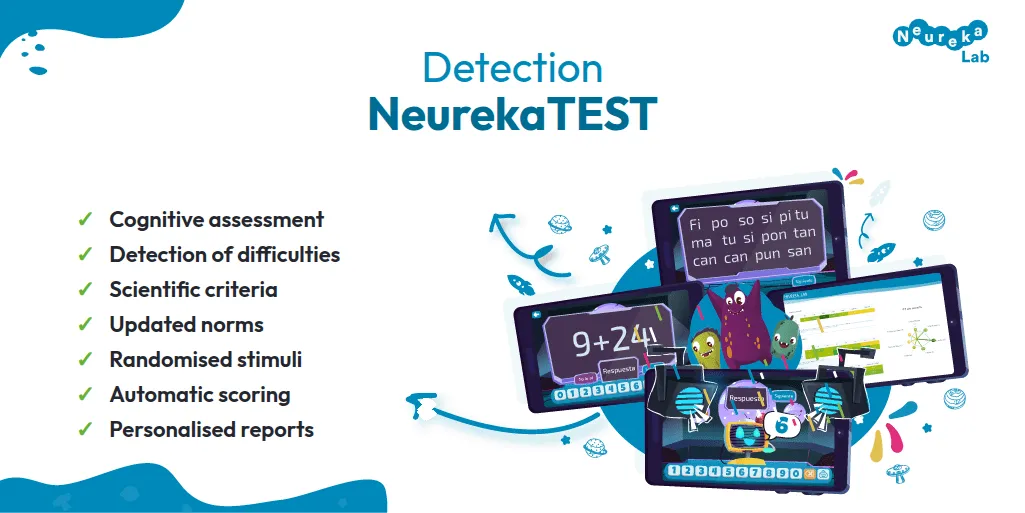
NeurekaTEST
At NeurekaLAB we offer NeurekaTEST, a tool based on scientific evidence and designed to detect the first signs of both learning difficulties and talent in children aged 5 to 12. The tool gathers the cognitive information assessed for each child and establishes a personalised profile adapted to their individual needs.
The NeurekaTEST tool is aimed at teachers and support teams, and makes it possible to assess the basic functions involved in school learning:
- NeurekaCALC: numerical processing and calculation.
- NeurekaLEC: reading processes.
How to support high intellectual ability
Accurately identifying students with high intellectual ability is a crucial task in contemporary education. Once these pupils have been identified, it is important to implement appropriate measures to adapt the education system to their specific needs, addressing both academic and social aspects. This adaptation not only involves providing richer and more challenging content in the classroom, but also fostering the interaction and social development of these students, thereby ensuring that they not only benefit from their intellectual potential but also become well-integrated individuals who contribute to society.
The role of the family in high ability
Families play a fundamental role in recognising and supporting these children. Often, the family may be the first to identify signs of exceptional abilities, such as rapid learning, insatiable curiosity or creative problem-solving. In this context, it is essential that families become active allies in education, working with teachers to provide an environment that favours the development of their children’s abilities. This includes using additional educational resources outside the classroom, encouraging their passions and interests, and fostering independent learning.
Families are expected not only to recognise and nurture these abilities, but also to help their children develop social and emotional skills so that they can face the challenges related to their high intellectual ability, such as academic stress and peer relationships. Through close collaboration between school and family, an optimal environment can be ensured for the growth and success of students with high intellectual ability.
The role of the school in high ability
The school environment is the initial setting where these talents can be detected through standardised tests or observation of pupils’ academic and creative abilities. It is essential that schools act with sensitivity and effectiveness in this recognition process.
Once students with high abilities have been identified, the school must take steps to adapt the educational environment to their specific needs. This means providing a more challenging and enriching curriculum that allows them to develop their potential. It is also essential to offer accelerated or differentiated learning opportunities so that they can advance in their areas of interest. In addition, schools must be aware of the importance of teacher training for the identification and appropriate support of pupils with high intellectual ability, as well as the importance of fostering a socially inclusive and supportive environment that promotes these students’ social and emotional skills.
Scientific evidence:
Departament d’Educació (Generalitat de Catalunya) (2013). Les altes capacitats: detecció i actuació en l’àmbit educatiu Guia per a mestres i professors.
Evaristo Barrera-Algarín, José-Luís Sarasola-Sánchez-Serrano, Abraham García-González & María Ruiz-Herrera (2023) Neglecting gifted students: its impact on scholastic failure: perception from the families (La no atención de las Altas Capacidades en la escuela y su relación con el fracaso escolar: percepción desde las familias), Culture and Education, 35:1, 120-154. DOI: 10.1080/11356405.2022.2121133.
García-Ron, A., & Sierra-Vázquez, J. (2011). Niños con altas capacidades intelectuales. Signos de alarma, perfil neuropsicológico y sus dificultades académicas. Anales de pediatría continuada, 9(1), 69-72.
Higueras-Rodríguez, Lina; Fernández Gálvez, Juan de Dios (2016) El papel de la familia en la educación de los niños con altas capacidades intelectuales. IJERI: International Journal of Educational Research and Innovation, 2016; (7) : pp. 149-163. URI: http://hdl.handle.net/10433/4921.
Pardo de Santayana, R. (2004). Alumnado doblemente excepcionales: superdotación intelectual y dificultades de aprendizaje. FAISCA: Revista de altas capacidades, 11, 37-46.
Solé-Casals J, Serra-Grabulosa JM, Romero-Garcia R, Vilaseca G, Adan A, Vilaró N, Bargalló N, Bullmore ET. Structural brain network of gifted children has a more integrated and versatile topology. Brain Struct Funct. 2019 Sep;224(7):2373-2383. DOI: 10.1007/s00429-019-01914-9.