Mathematics is fundamental to everyday life and education, as it allows us to understand and manage essential aspects of daily life and lays the foundations for learning with numbers. During the first years of school, mathematics is crucial because it helps develop logical thinking, reasoning ability and problem-solving skills. These years form the basis for future learning and are decisive in building a solid understanding of the numerical and arithmetic concepts that will be useful throughout life.
In recent years, digital technology has revolutionised the learning of mathematics through more playful and motivating tools, using interactive games and educational apps that automatically personalise the experience. This transformation has made it possible to address maths difficulties and dyscalculia with innovative resources that facilitate a deeper, more accessible understanding of mathematical concepts.
Maths difficulties and dyscalculia
For some children, mathematics can be a challenge that affects their learning. Mathematics learning difficulties are limitations that some students experience when it comes to understanding, processing and applying mathematical concepts. These difficulties can manifest themselves in various ways and affect pupils’ academic performance and self-esteem. Dyscalculia is a specific learning disorder that affects the understanding of basic numerical and arithmetic concepts. Children with dyscalculia often have difficulties understanding and manipulating numbers, performing simple calculations and remembering basic mathematical facts, despite having average intelligence for their academic level. This challenge can significantly affect their academic performance and self-esteem.
Early identification and the implementation of appropriate interventions for maths difficulties and dyscalculia are crucial to help these children develop their mathematical skills. Adapted educational strategies can improve their numerical understanding and arithmetic skills, and contribute to a more positive and effective learning experience.
Early intervention for maths difficulties and dyscalculia
Early intervention is essential to provide children with maths difficulties and at risk of dyscalculia with the support and resources they need for academic success. While there is no scientific evidence establishing the effectiveness of any specific intervention, it has been shown that maths difficulties persist and increase if they are not addressed from the early years of primary education (between the ages of 5 and 8), the crucial stage for acquiring the foundations of mathematics learning. Identifying these children at an early age allows mothers, fathers and teachers to implement learning strategies adapted to their individual needs.
Intervention tasks in numerical processing
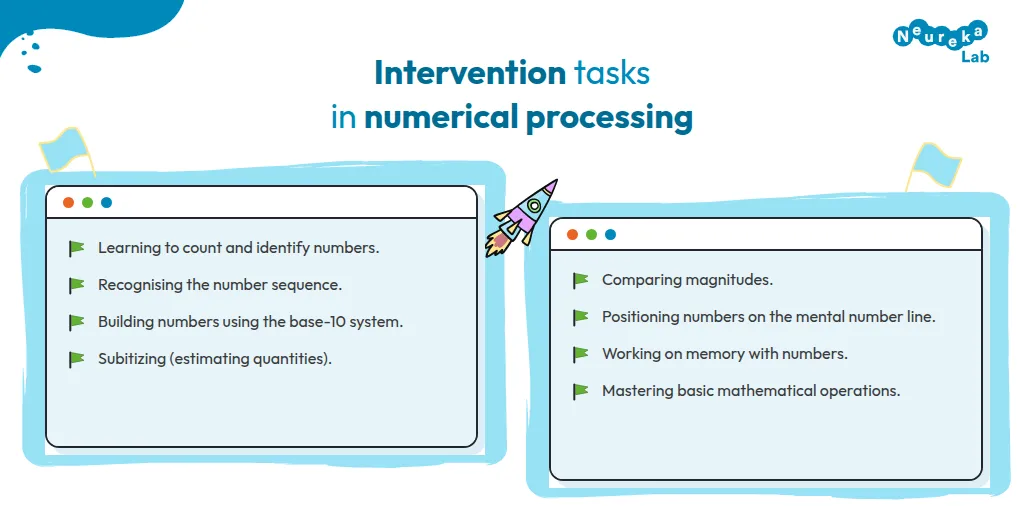
Building on scientific knowledge of numerical processing and calculation, a number of intervention tasks in the field of mathematics have been established and have proved effective in improving young children’s numerical skills. Incorporating these tasks in digital format provides an enriching, motivating and easily accessible experience.
Below are the numerical processing intervention tasks that have proved effective in improving mathematical skills during the early years of primary education:
- Learning to count and identify numbers. Knowing the Arabic numeral system is crucial to understanding the symbolic representation of numbers.
- Recognising the number sequence. Through mathematical reasoning, children consolidate their knowledge of the sequential order of numbers.
- Building numbers using the base-10 system. Assimilating the base-10 system allows children to create units, tens, hundreds and thousands.
- Subitizing. Estimating quantities from a set of elements consolidates the understanding of numerical value.
- Comparing magnitudes. With both symbolic and non-symbolic representations, children are able to distinguish between the smallest and the largest value.
- Positioning numbers on the mental number line. Understanding the sequential order of numbers provides the ability to mentally place numbers in order of value on an imaginary line.
- Working on memory. Recalling numbers over a specific period of time strengthens the retrieval of information in working memory.
- Mastering basic mathematical operations. Regular practice of mental arithmetic is essential to consolidate basic operations such as addition, subtraction, multiplication and division.
Digital technology in the intervention of maths difficulties
Advances in digital technology within education have provided new tools to encourage learning and practice in children with maths difficulties and dyscalculia. A recent study by Giordano et al. (2023) highlights how incorporating digital tools into mathematics learning can improve the skills of children with dyscalculia and learning difficulties in this area thanks to the use of objective performance data, as they provide dynamic, personalised environments that adapt to individual development. This improvement was not observed in cases where the digital tools provided feedback that caused children stress; for this reason, it is important to plan a design based on scientific evidence to increase the effectiveness of the digital intervention and maintain children’s motivation.
Digital technology can make mathematics more accessible and engaging for children with learning difficulties. Interactive virtual environments not only keep children interested but also offer a safe, controlled way to practise and improve their skills.
NLab Family
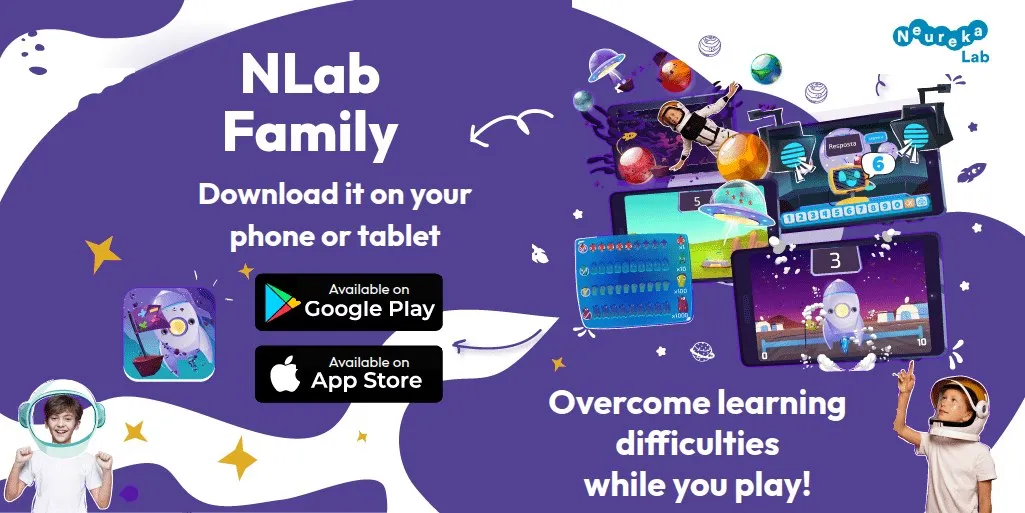
When maths difficulties or dyscalculia are present, we offer NLab Family, the mobile and tablet app available for Android and iOS, with which children aged 5 to 8 can play while learning anywhere, at any time.
The NLab Family app, scientifically validated by the Universitat de Barcelona and the Universitat de Vic - Universitat Central de Catalunya, provides an initial screening test and offers playful, evidence-based activities, using the NeurekaNUM methodology, to improve the learning process of children with maths difficulties and dyscalculia. Sessions last a maximum of 15 minutes a day, to ensure regulated, optimal use so children gain the app’s benefits in improving their mathematical skills.
Scientific evidence:
Decarli, G.; Sella, F.; Lanfranchi, S.; Gerotto, G.; Gerola, S.; Cossu, G.; Zorzi, M. (2023). Severe Developmental Dyscalculia Is Characterized by Core Deficits in Both Symbolic and Nonsymbolic Number Sense. Psychol Sci. 2023 Jan;34(1):8-21. DOI: 10.1177/09567976221097947. Epub 2022 Oct 25. PMID: 36282938.
Gatell Carbó, A., Vergés Castells, A., Serra Amaya, C., Alda Díez, J. A., Grau, N., Elias Abadias, M.; Gatell Carbó, A. i Vergés Castells, A. (coordinació); Morales Hidalgo, V., Sans Fitó, A. i Serra Grabulosa, J. M. (col·laboració); Bosch Hugas, J. (il·lustracions) (2022). Trastorns del neurodesenvolupament i l’aprenentatge: Abordatge des de pediatria d’atenció primària. (1ª edició: gener de 2022) https://docs.academia.cat/i9605419
Giordano, G., Alesi, M., & Gentile, A. (2023). Effectiveness of cognitive and mathematical programs on dyscalculia and mathematical difficulties. En International review of research in developmental disabilities (pp. 217-264). DOI: 10.1016/bs.irrdd.2023.08.004.