In the course of the accelerated growth of digital technology, it has permeated the educational environment in a significant way. This dizzying evolution poses a challenge for teachers, as they need to adapt to a new educational paradigm that integrates electronic devices, interactive applications and innovative digital tools. Beyond the simple introduction of these new devices, this transition is redefining the way children learn and interact with knowledge.
The application of technology in teaching not only opens up a wide range of opportunities, but also raises questions about how it can improve learning. This invites reflection on the challenges and concerns in this new educational ecosystem. The application of technology demands a process of adaptation and learning in order to maximise the benefits it can bring to students’ education.
Technology in education
The integration of technology in education has given rise to multiple success stories that have transformed learning dynamics. Scenarios have been observed in which students immerse themselves in interactive and dynamic environments, encouraging their participation and motivation. Digital tools have made it possible to adapt educational resources to pupils’ individual needs, offering a more personalised learning experience. However, despite these successes, there are still barriers to overcome. Often, a lack of knowledge or specific training can lead to inappropriate use of technology in classrooms, limiting its potential benefits.
It is vital to understand that the presence of electronic devices does not automatically guarantee an improvement in, or harm to, teaching. According to various studies in this field, digital technology does not in itself have significant effects on education; rather, it is the use made of it that matters. This implies not only mastering technological tools, but also developing pedagogical skills to make optimal use of these resources in education.
Benefits of technology applied in education
The effective integration of technology in education is not limited to the mere presence of digital devices in classrooms; it lies in a deep understanding of the specific characteristics of the different technologies and their planned application. It is crucial to establish a meticulous educational strategy, adapted to students’ individual needs.
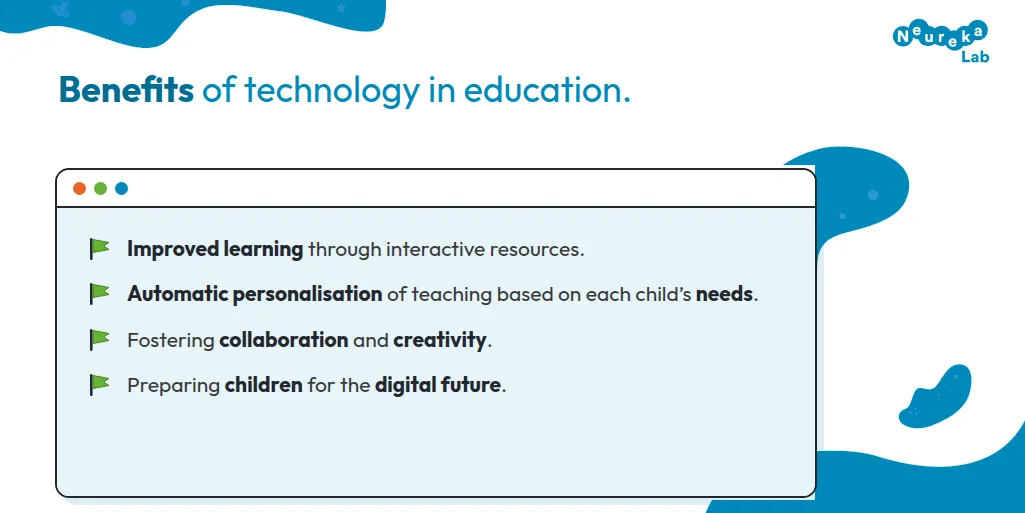
Various studies agree on some of the benefits of integrating technology in education:
- Improved learning through interactive resources. The use of interactive resources provides a more dynamic and captivating experience, encouraging students’ motivation and participation in the classroom.
- Personalisation of teaching according to the student’s needs. Personalising teaching through technology makes it possible to adjust the pace and educational content to each student’s specific needs, optimising their progress.
- Encouragement of collaboration and creativity. Technology encourages collaboration between students and stimulates creativity through tools and platforms that enable joint work.
- Preparing students for the digital future. Applying technology in the educational environment prepares students for the integration of digital knowledge, equipping them with the skills and understanding they need to adapt to an increasingly digitalised world.
Concerns and risks of technology in education
The increased use of technology in education raises various concerns and risks that require careful consideration. One of the main concerns is the possibility of excessive dependence on technological devices, which could reduce students’ capacity for self-regulation and concentration on tasks that do not require the use of technology, negatively affecting their learning.
Another adverse effect observed with the unregulated use of technology in children and young people is the presence of behavioural problems associated with inappropriate or excessive use of technology in classrooms, leading to a lack of attention, impulsiveness or reduced social and communication skills.
For this reason, it is important to address these risks with a strategic perspective. It is necessary to implement measures that promote responsible use of technology, foster equity of access and establish clear limits in order to achieve a balance between the advantages of technology and the associated risks. This awareness will make it possible to harness the benefits of technology in education without compromising students’ wellbeing.
Validated considerations and recommendations on technology in education
A recent statement from the Spanish Association of Paediatrics (AEP) highlights the need to protect the physical, mental, sexual and social health of children and adolescents against the misuse of digital technology, which, applied without conscious regulation, can negatively influence neurodevelopment and learning during these vital stages. Despite the lack of conclusive evidence on the benefits of indiscriminately banning the use of mobile devices, the AEP insists on the importance of establishing regulation that requires children’s programmes to comply with specific obligations.
In view of this concern, the AEP stresses the need to provide knowledge and training about technology at all levels, from childhood and adolescence to parents, educators and the community at large. Through the AEP’s Family Digital Plan, healthy use of technology is promoted as a fundamental tool for preserving young people’s health and wellbeing in today’s digital environment.
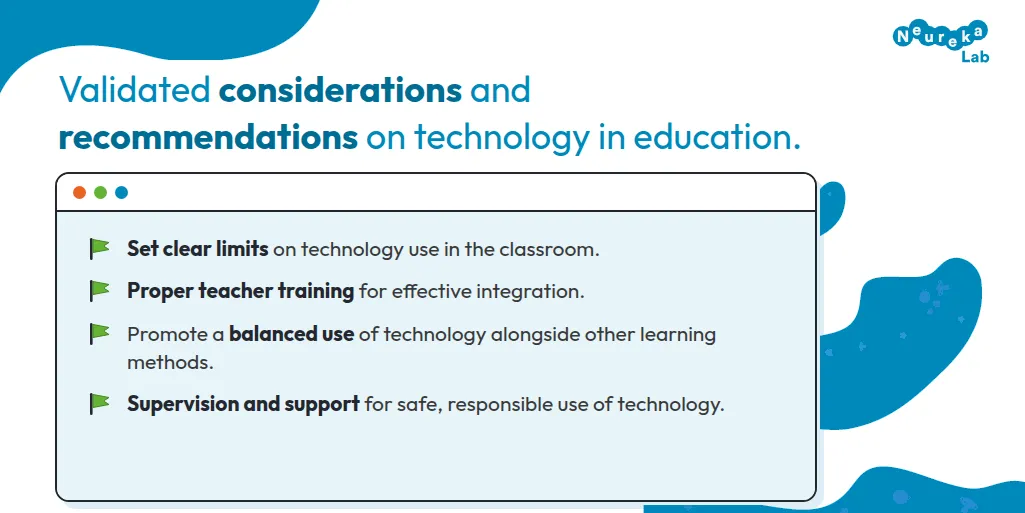
Taking into account the AEP’s considerations on the use of technology in classrooms and the various studies that have examined the integration of technology in education, the following general recommendations can be gathered:
- Establish clear limits on the use of technology in the classroom. Define specific rules and guidelines on when and how technology can be used during lessons to ensure appropriate and productive use.
- Adequate teacher training for effective integration. Provide educators with comprehensive and ongoing preparation on how to incorporate and use technological tools effectively within the school curriculum.
- Promote a balanced use of technology alongside other learning methods. Encourage the diversification of teaching strategies, applying technology as a complementary learning resource, not as an exclusive substitute for other forms of teaching.
- Supervision and support for safe and responsible use of technology. Guarantee constant supervision and the necessary support so that students use technologies safely, understanding the associated risks and adopting responsible practices while connecting to the digital world.
Scientific evidence:
Higgins, Steven; Xiao, ZhiMin; Katsipataki, Maria (2012). The Impact of Digital Technology on Learning: A Summary for the Education Endowment Foundation. Education Endowment Foundation (EEF) (United Kingdom); Durham University (United Kingdom). ERIC Number: ED612174. https://eric.ed.gov/?id=ED612174
Sanders, T., Noetel, M., Parker, P. et al. (2023). An umbrella review of the benefits and risks associated with youths’ interactions with electronic screens. Nat Hum Behav. DOI: 10.1038/s41562-023-01712-8.