Video games have evolved beyond mere distraction. Their inclusion in the educational environment as a motivating and enriching tool has transformed the way children learn and interact with the world around them. Gamification has become a captivating strategy for encouraging participation and immersion in a range of subjects, creating a more engaging learning experience for students.
What is PEGI: Pan European Game Information
Pan European Game Information (PEGI) is a labelling system that provides information about the appropriate age for consuming video games and their content. Its main purpose is to guide consumers - or buyers, especially parents, guardians and educators - on the suitability of games for different ages. It also includes indications of content featuring elements that may be considered sensitive or harmful for certain ages and profiles.
The PEGI labelling system provides classifications by age and by type of content across different European countries, and consolidates unified categorisation criteria for a range of digital products such as video games, television programmes, films, mobile applications and so on.
How PEGI labelling works
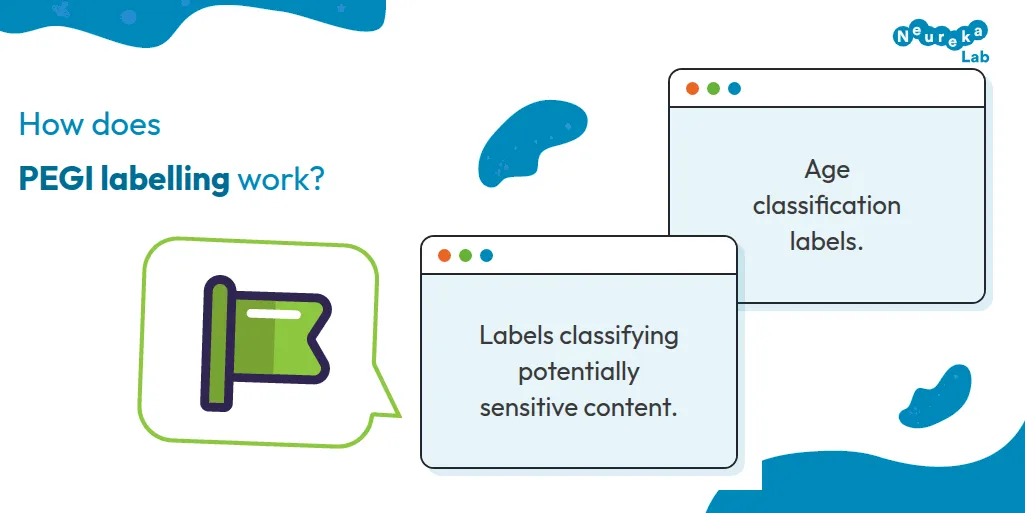
The purpose of PEGI is to provide valuable information about video games and digital content so that the best purchasing decision can be made, suited to the target audience. To get the most out of this labelling system, it is important that users understand the different PEGI classifications. PEGI labels are divided into two main categories:
-
Age classification labels. These indicate the minimum recommended age at which the video game or digital product is aimed. This label does not indicate the level of difficulty of a game, but rather whether or not the product is suitable according to the consumer’s age, whether due to cognitive development, educational level, etc.
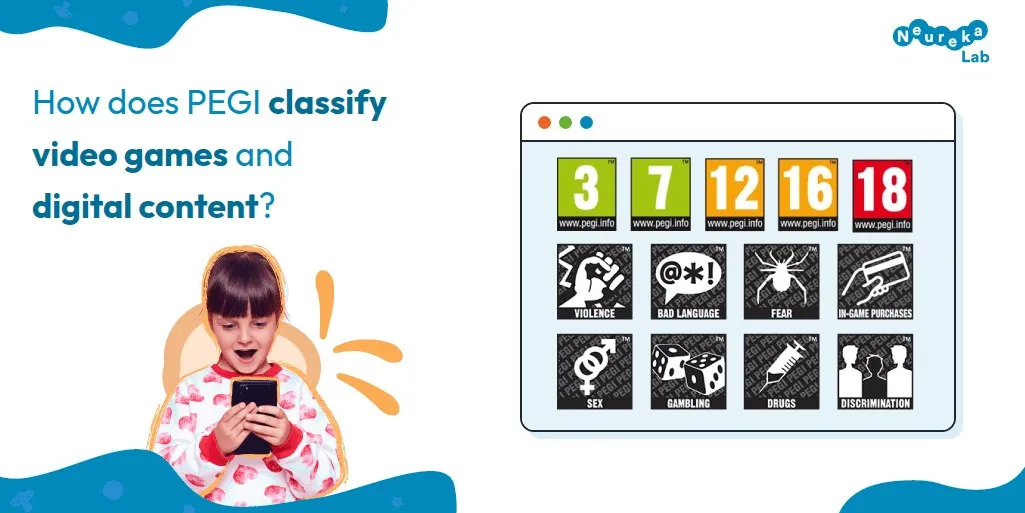
Age classification labels are divided into five recommended ages (PEGI 3, PEGI 7, PEGI 12, PEGI 16 and PEGI 18), distinguished by the age number and a green, orange or red background reminiscent of a traffic light. Within the age category, the “PEGI !” label, known as “Parental Guidance”, also stands out; it can group together various types of content suitable for different ages and therefore requires adult supervision. The “PEGI “ label is usually present on social media products such as Facebook, Twitter or Instagram.
-
Labels classifying potentially sensitive content. Apart from the age label, a digital product may also carry a label with a black background and a descriptive title indicating the presence of content that may be sensitive or harmful. The sensitive content types that PEGI classifies are as follows: violence, bad language, fear, gambling, explicit content, drugs, discrimination, and in-game purchases.
The PEGI platform features an open search tool so that users can consult, at any time and in an up-to-date manner, the rating awarded to a large proportion of video games and digital products.
How PEGI classifies video games and digital content
For a digital product or video game to carry the corresponding official PEGI label, it must undergo a thorough assessment to validate it. The PEGI assessment process differs depending on the nature of the product, that is, whether it is sold in physical or digital format.
-
Classification for physical video games. In the case of games sold in shops as physical products, before their release, publishers must complete a detailed form about the game’s content. This questionnaire assesses aspects such as violence, inappropriate language or other content that is not suitable for all ages. Based on the answers, PEGI determines a provisional classification with descriptive labels.
After this initial process, PEGI administrators review this provisional classification, adjusting it if necessary. Once the final classification is approved, the publisher of the physical game receives a licence to use the age classification icon on the packaging or in its advertising.
-
Classification for digital video games or products. The International Age Rating Coalition (IARC) is a global classification system that operates in the digital marketplace of different countries and regions around the world, and uses generalised standards to adapt them to the classification of each region or country - in the case of Europe, it transfers them to the PEGI format. Developers submit their game to the store and complete a questionnaire about its content. With this single questionnaire, developers immediately receive the age classification from different rating boards.
As soon as the game is released in the digital store, the corresponding age rating is displayed. The administrators of the IARC boards work together to ensure that ratings are applied accurately across all markets. If an error is detected, the rating can be corrected quickly.
Responsible consumption of video games and digital content
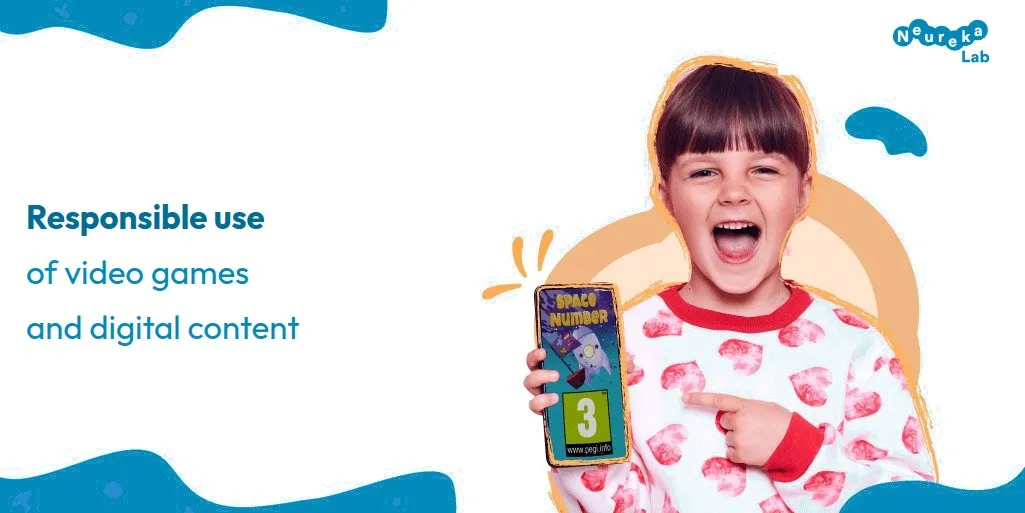
Both families and educators express concerns about how to supervise children’s video game consumption. In response, guidance platforms have been developed that offer advice and resources for responsible consumption. Platforms such as PEGI or The Good Gamer firmly believe that video games can be a beneficial tool for supporting education, provided they are used in a regulated and responsible way.
In the field of research, several studies consider that age classifications such as PEGI can be a useful tool for making purchasing decisions, but the direct involvement of adults is also needed to properly regulate and supervise what children consume.
Tips for responsible consumption
Ensuring responsible use of video games is essential to make the most of their benefits for children’s learning and cognitive development. This responsibility falls on parents, guardians and educators, who are asked to be actively involved, bearing in mind the following considerations:
- Understand the meaning of PEGI labelling. To make an informed purchasing decision and choose a video game wisely, it is worth learning about the classification recommendations, the content on offer and how this information is represented on the different classification labels.
- Look for games suited to the player’s age and profile. PEGI labelling offers valuable information about the suitability of a game or digital product according to the audience it is aimed at. Even so, it is important to understand the individual needs of each child, which may not match the standardised recommendations.
- Regulate playing time. It is essential to know how to balance playing time so as not to lose touch with reality. It is recommended not to exceed 9 hours per week in front of screens so as not to interfere with academic performance and social relationships.
- Encourage playing in company. Another way to play without losing touch with reality is to share playing time with friends or family. Parents who play with their children can supervise the content they consume and gain a better understanding of their tastes and specific needs.
Scientific evidence:
Felini, Damiano. (2015). Beyond today’s video game rating systems: A critical approach to PEGI and ESRB, and proposed improvements. Games and Culture, 10(1), 106-122. DOI: 10.1177/1555412014560192.
Guerra Antequera, Jorge.; Revuelta Domínguez, Francisco Ignacio. (2016). Análisis del conocimiento del código PEGI en la formación inicial del profesorado. RELATEC: revista latinoamericana de tecnología educativa. DOI: 10.17398/1695288X.15.1.87.
Kosiorowska, Malgorzata. (2013) The Pan-European Game Information (PEGI) age rating system–a helpful tool for parents buying computer, video games for children.