Mathematics plays a major role in academic learning, not only within its own subject but also in later subjects that require calculation and mathematical reasoning — such as technology, physics or statistics — as well as in everyday life — doing the shopping, telling the time, calculating measurements, and so on. This is why, from an early age, schools insist that pupils become familiar with numbers and mathematical thinking.
What are maths difficulties and dyscalculia?
Research into mathematics learning difficulties confirms that they are present in every classroom and can arise from a range of factors. When these difficulties are more severe, it is possible to identify the presence of dyscalculia, a disorder of neurobiological origin that affects the perception of numbers, numerical processing and calculation.
Both dyscalculia and maths difficulties in general can prevent a child from meeting curriculum requirements, triggering a lack of motivation, a feeling of being left behind, low self-esteem, adjustment difficulties and even school failure. For this reason, teachers, education professionals and families must know how to act in time to support the child’s learning in this area of knowledge.
How to recognise maths difficulties in time
There are certain indicators that match the habits and behaviours of children with mathematics learning difficulties. These are some of the indicators that can help detect possible maths difficulties:
- Difficulties reading numbers.
- Problems performing basic calculations.
- Doing simple calculations with their fingers.
- Difficulties understanding problem statements.
- Using mathematical symbols incorrectly.
- Limited ability to relate numbers to one another.
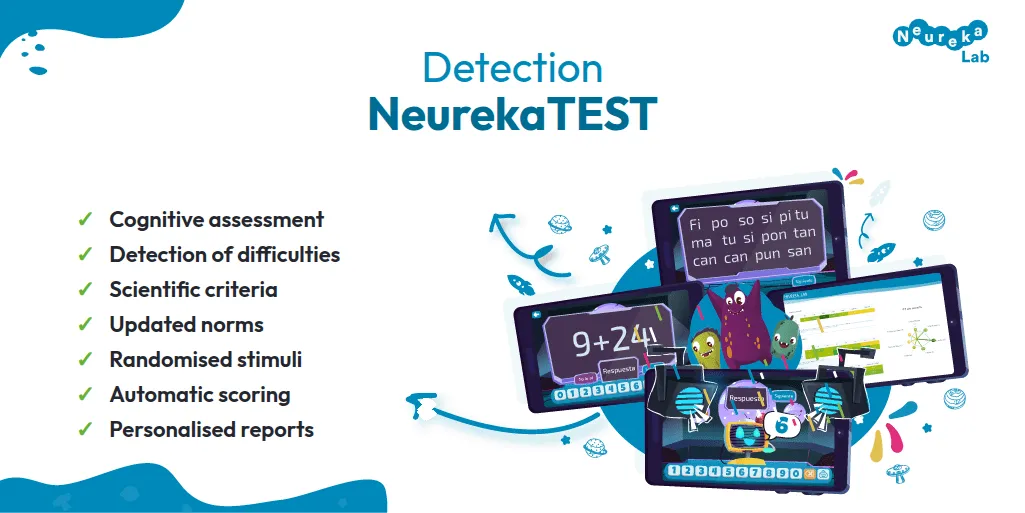
NeurekaTEST is a tool for detecting a range of learning difficulties, aimed at children between the ages of 5 and 12. It includes different activities, among them NeurekaCALC, to assess numerical processing and calculation.
The four main domains of mathematical thinking
Maths difficulties are heterogeneous — that is, they can have different causes. That is why the various domains must be assessed whenever maths difficulties are suspected.
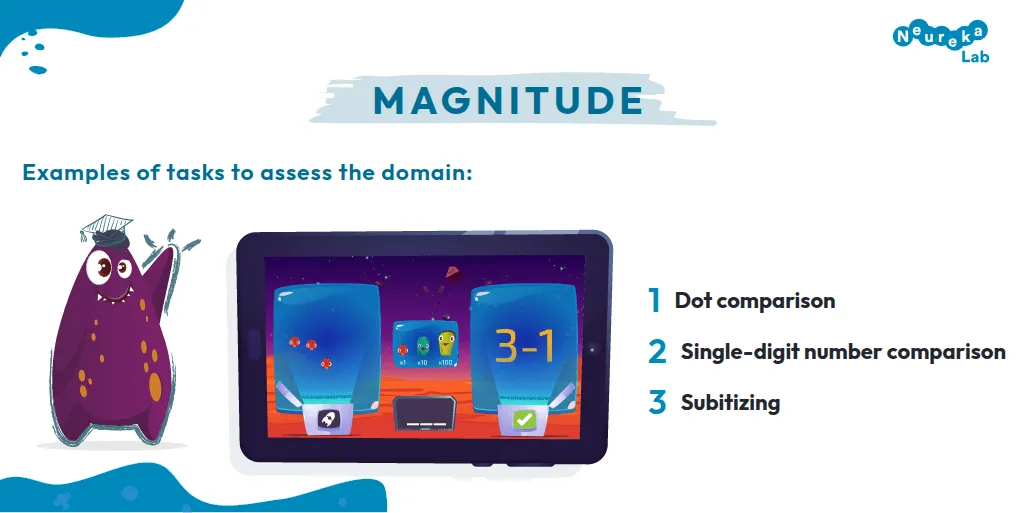
1. Magnitude
The magnitude domain is understood as the core of numerical processing and calculation. It underpins the learning that takes place through schooling and covers both symbolic and non-symbolic aspects.
Examples of tasks to assess the ‘magnitude’ domain:
2. Memory/verbal
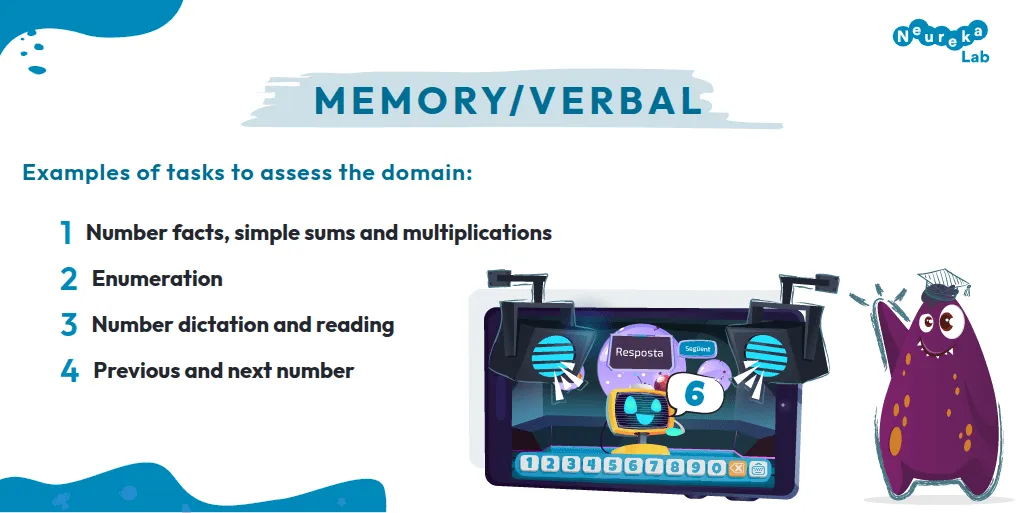
The memory/verbal domain is understood as the one covering learning based on the repetition/memorisation of knowledge and numerical decoding.
Examples of tasks to assess the ‘memory/verbal’ domain:
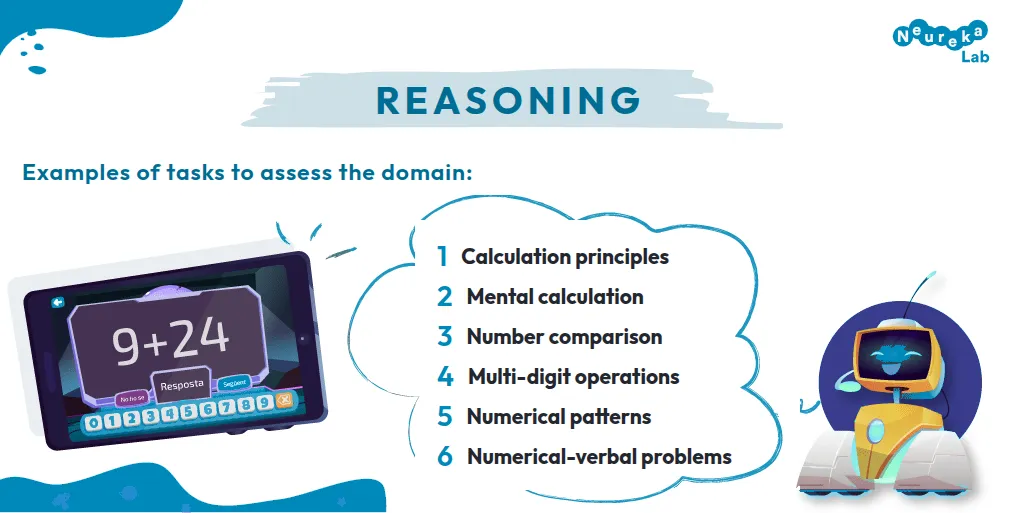
3. Reasoning
The reasoning domain covers those processes based on the functioning of executive functions.
Examples of tasks to assess the ‘reasoning’ domain:
4. Visuospatial
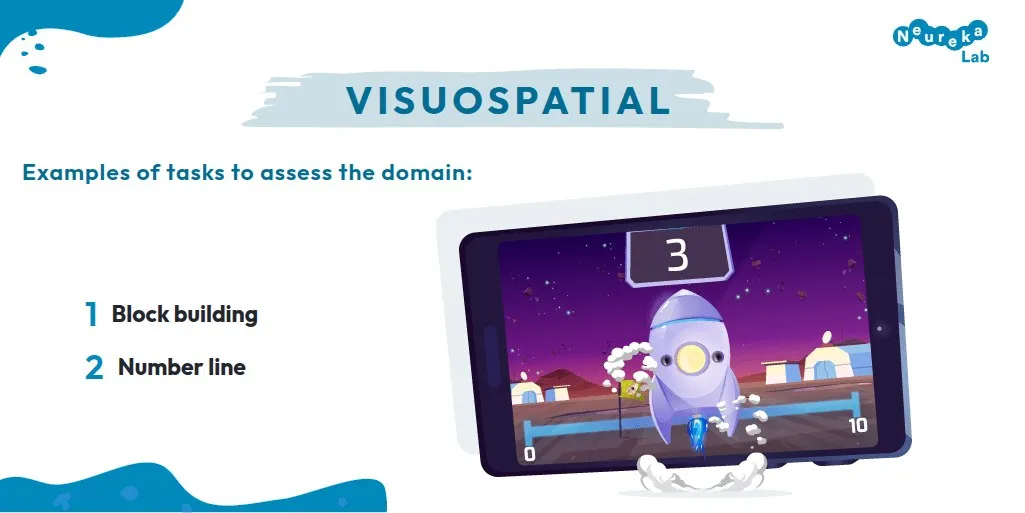
The visuospatial domain covers those processes based on the spatial arrangement of objects and their relationships.
Examples of tasks to assess the ‘visuospatial’ domain:
Intervention to tackle maths difficulties and dyscalculia
Once the domains that need strengthening have been identified, it is time to take action. While it is true that dyscalculia is a disorder with no cure, acting in time will help reduce its negative impact on the child’s development of mathematical processing throughout their life.
The NeurekaNUM method
At NeurekaLAB, we have developed the NeurekaNUM method with the aim of improving numerical consistency and the basic skills of numerical processing and calculation. Grounded in scientific evidence, it seeks to build greater confidence and fluency in handling numbers, providing the tools needed to tackle mathematical learning. It is designed to work on the following aspects of numerical processing:
- Number awareness.
- The mental number line.
- The base-10 system.
- Numerical working memory.
- Calculation.
- Mathematical reasoning.
- Visuospatial working memory.
- Visuospatial attention.
- Arithmetic problem solving.
- Magnitude comparison.
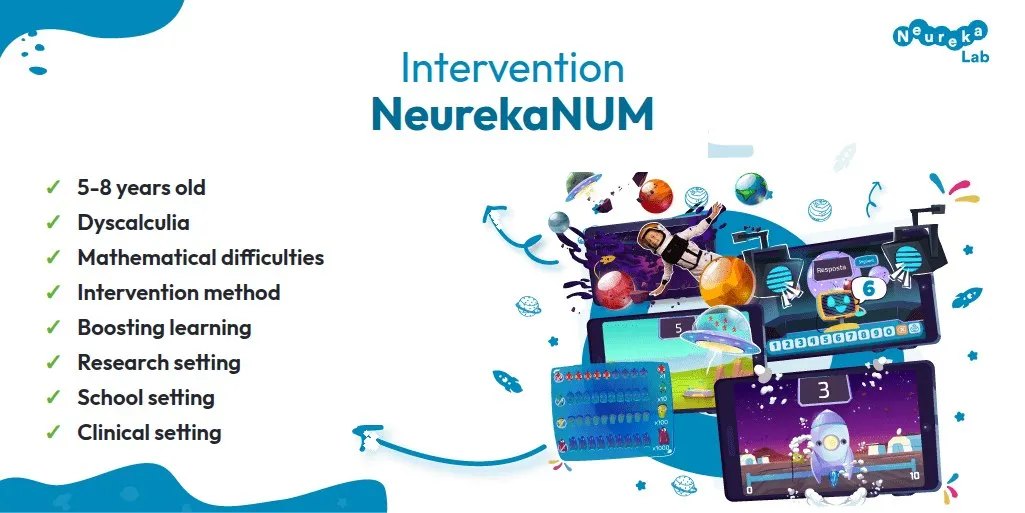
It is a fully automated method that uses artificial intelligence to create a specific profile for each child, adjusting the type of activities to their performance in each aspect. Both professionals and families can monitor performance.