Dyslexia is a neurodevelopmental disorder that affects the acquisition of reading and writing in approximately 10% of school-age children. It is an unexpected difficulty in reading for people without any sensory impairment, and is often related to problems with phonological processing, that is, with perceiving the individual sounds of spoken language. Several studies have explored the importance of early identification of dyslexia and how behavioural measures can improve the detection of dyslexia risk in pre-reading children.
Early identification of dyslexia risk
Today, thanks to scientific research, data have been gathered that make it possible to clearly identify the most characteristic features of dyslexia. Against this backdrop, several authors support the idea of harnessing and further developing new tools and methodologies for detecting dyslexia before formal reading instruction, known as the pre-reading age, which is also considered the age at which response to intervention is most effective. The early identification of dyslexia risk has important implications for mitigating its impact on the child and improving the psychosocial consequences associated with reading failure.
Predictive factors of pre-reading skills
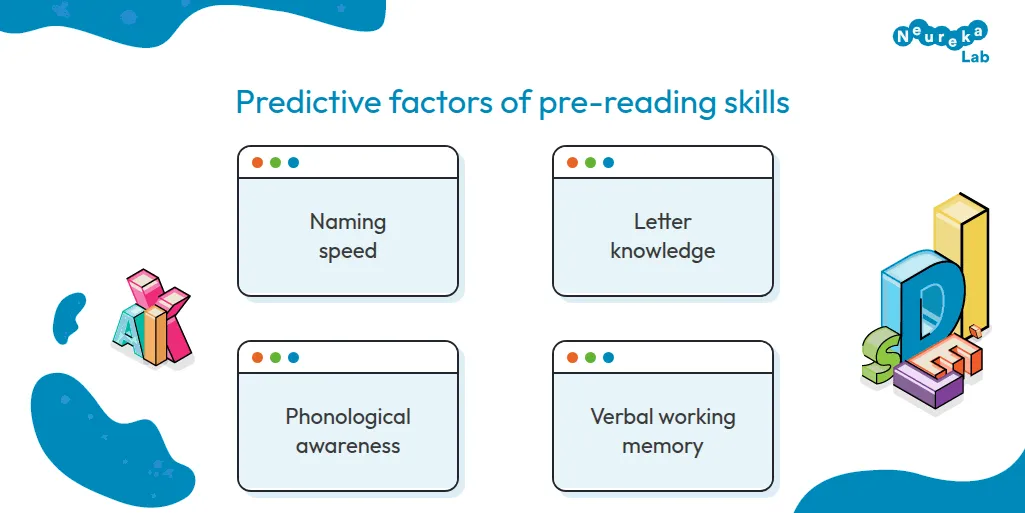
While it is true that the ability to predict dyslexia risk may vary depending on the language, the study by Ozernov-Palchik et al. (2016) focused on detecting possible dyslexia in a group of children in early childhood education, that is, before formal reading instruction. To do so, they based the study on four variables that can help predict the risk of dyslexia: naming speed, letter knowledge, phonological awareness and verbal working memory.
Naming speed
Naming speed is a measure used in the field of cognitive psychology to assess how quickly a person can name or recognise an object or a word. It is an indicator of mental processing speed and is related to memory function and language skills. It should be noted, however, that this variable can vary depending on familiarity with the objects or words presented, as well as age, aspects related to cognitive processing or the presence of fatigue.
Letter knowledge
Letter knowledge is understood as a child’s ability to recognise, identify and know the letters of the alphabet before acquiring reading skills. As children acquire letter knowledge, they can learn to identify letters by name and recognise them in different words and in different formats.
Phonological awareness
As children acquire letter knowledge, they lay the foundations for understanding that letters represent specific sounds. Phonological awareness is the ability to recognise, manipulate and play with the sounds of language, and it is fundamental to the development of reading and writing skills, as well as to acquiring reading fluency, since it allows readers to recognise patterns and groupings of sounds in longer or unfamiliar words.
Verbal working memory
Working memory is a cognitive process that gathers temporary information and enables complex tasks to be completed. In the field of reading, the phonological loop is a component of verbal working memory that has the capacity to retain and manipulate verbal information, such as words or sentences, immediately and temporarily. It plays a key role in various language-related cognitive tasks, such as reading comprehension, listening comprehension and vocabulary learning.
Short screening tests focusing on word and letter-sound recognition, awareness of language sounds, naming speed and verbal working memory, administered individually to children in nursery and the beginning of early childhood education, are tools with a strong ability to predict future reading level (Gabrieli, 2009).
Response to intervention in dyslexia
To address and improve reading difficulties, various research studies have confirmed that early intervention is more successful than late intervention (Caravolas, Volin and Hulme, 2005; Gabrieli, 2009; Torgesen et al., 2001). Therefore, the older the child, the worse the prognosis and the response to treatment. This underlines the importance of early detection in children at risk of dyslexia, identifying the variables that can predict reading development (Hulme and Snowling, 2016). In this way, intervention methodologies and programmes can be developed to help the children who need them (Fuchs and Vaughn, 2012; Snowling and Hulme, 2012).
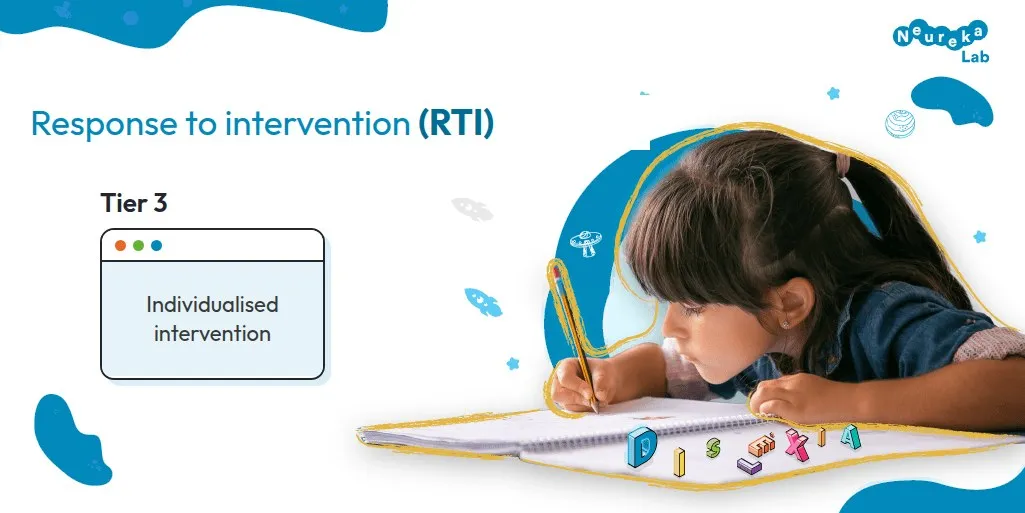
Response to intervention (RTI) has been the most widely used methodology for the assessment and treatment of dyslexia across several scientific studies. At the third tier of this intervention, that is, when the intervention is individualised, an improvement in outcomes has been observed for some children, although this improvement can vary depending on each individual’s specific profile.
Research into this methodology has identified that students with dyslexia who have difficulties with phonological awareness, slow letter-naming speed, low verbal ability and developmental delays are more likely not to respond adequately to intervention. It has also been observed that children with problematic behaviour may show greater difficulty responding to early literacy interventions, even when these are adapted on an individual basis. These factors must be taken into account when designing effective intervention programmes for dyslexia.
Although the response to intervention may vary depending on the student’s profile, strategies that work to address difficulties in phonological awareness and other key factors can be beneficial for students with dyslexia. With a deeper understanding of the neurobiological bases of this disorder and an integrated approach combining early detection and individualised attention through the RTI methodology, it is possible to help improve outcomes and quality of life for children with dyslexia.
A digital tool for detecting dyslexia
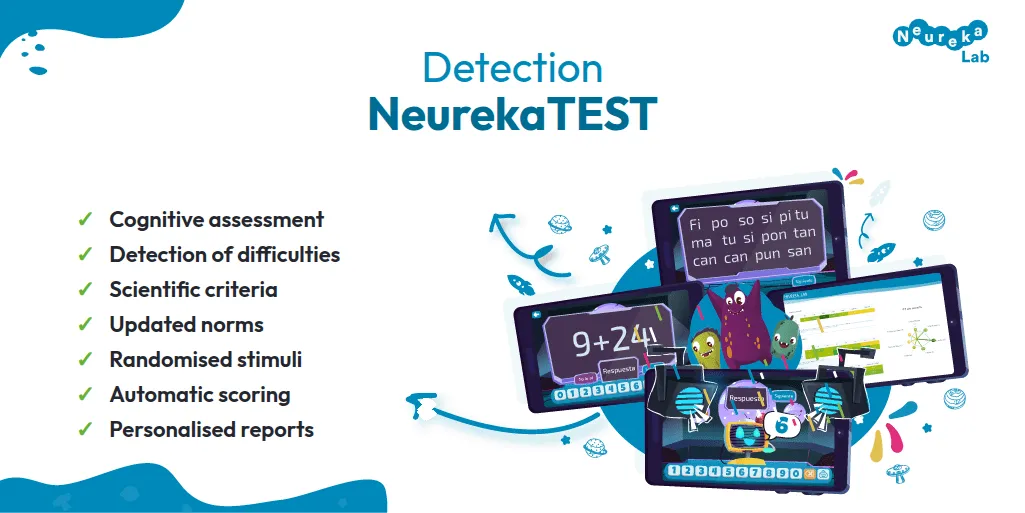
The NeurekaTEST tool, based on scientific evidence, is designed to detect the first signs of learning difficulties in children aged between 5 and 12. When signs of dyslexia are suspected, families, education professionals and schools can pay special attention to assessment using NeurekaLEC, which makes it possible to understand how easily the child reads and their reading comprehension. The tool gathers the cognitive information assessed for each child, establishing a personalised profile adapted to their individual needs.
Scientific evidence:
Caravolas, M., Volin, J., & Hulme, C. (2005). Phoneme awareness is a key component of alphabetic literacy skills in consistent and less consistent orthographies: Evidence from Czech and English children. Journal of Experimental Child Psychology, 92, 107-39. DOI: 10.1016/j.jecp.2005.04.003.
Fletcher JM, Stuebing KK, Barth AE, Denton CA, Cirino PT, Francis DJ, Vaughn S. Cognitive Correlates of Inadequate Response to Reading Intervention. School Psych Rev. 2011;40(1):3-22. DOI: 10.1080/02796015.2011.12087725.
Forné, S. (2020). Canvis cognitius i cerebrals associats a una intervenció fonològica intensiva en alumnes amb dificultats lectores. [Tesi de doctorat, Universitat Autònoma de Barcelona]. https://www.tesisenred.net/handle/10803/670503#page=1
Fuchs, L.S., & Vaughn, S. (2012) Responsiveness-to-intervention: a decade later. Journal of Learning Disabilities, 45(3), 195-203. DOI: 10.1177/0022219412442150.
Hulme, C., & Snowling, M. J. (2016). Reading disorders and dyslexia. Current Opinion in Pediatrics, 28 (6), 731-35. DOI: 10.1097/MOP.0000000000000411.
Ozernov-Palchik O, Gaab N. Tackling the ‘dyslexia paradox’: reading brain and behavior for early markers of developmental dyslexia. Wiley Interdiscip Rev Cogn Sci. 2016 Mar-Apr;7(2):156-76. DOI: 10.1002/wcs.1383.
Ozernov-Palchik O, Norton ES, Sideridis G, Beach SD, Wolf M, Gabrieli JDE, Gaab N. Longitudinal stability of pre-reading skill profiles of kindergarten children: implications for early screening and theories of reading. Dev Sci. 2017 Sep;20(5):10.1111/desc.12471. DOI: 10.1111/desc.12471.
Snowling, M. J., & Hulme, C. (2012). Interventions for children’s language and literacy difficulties. International journal of language & communication disorders, 47(1), 27–34. DOI: 10.1111/j.1460-6984.2011.00081.x.
Torgesen, J. K., Alexander, A. W., Wagner, R. K., Rashotte, C. A., Voeller, K. K. S., & Conway, T. (2001). Intensive remedial instruction for children with severe reading disabilities: Immediate and long-term outcomes from two instructional approaches. Journal of Learning Disabilities, 34(1), 33-58. DOI: 10.1177/002221940103400104.